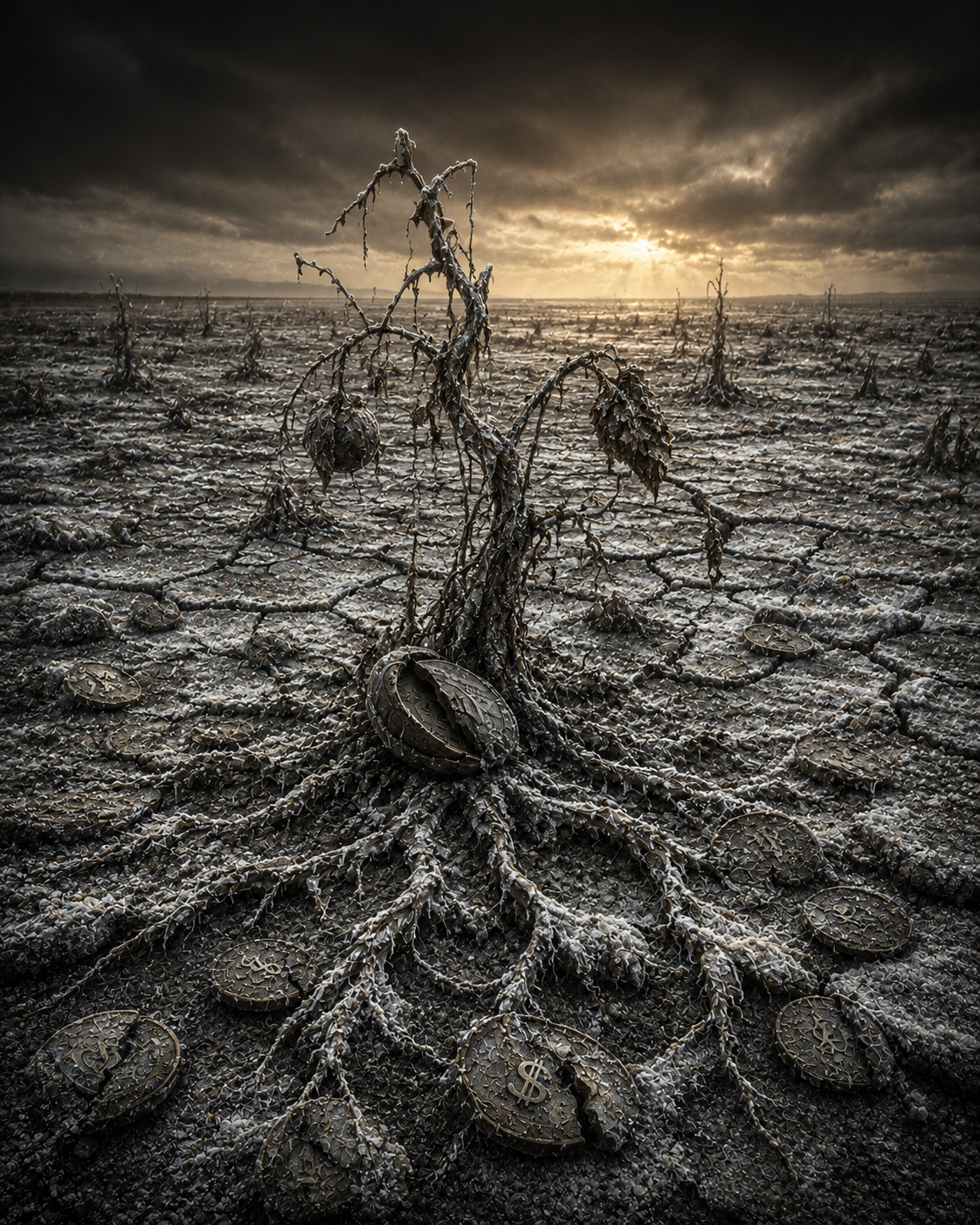
Book Two of The Overwintering Trilogy
The cold doesn’t stop at the border.
If Winterkill was the American winter, The Salted Ground is the winter going global — country by country, each one falling in its own language. The most defended nation on earth falls last and falls hardest: immaculately, lawfully, every safeguard still standing and gleaming and pointed at a door no one ever needs to use. Another, with too few young people to carry both the old and the future, doesn’t have its hope crushed so much as watch it grow old and tired and quietly bend back down. There is even a false dawn — a reform, a stirring, a season when it looks like the thaw has finally come — and then the ground takes it back.
This is the barren middle of the trilogy, and it earns its name. Salted ground is land where, after the burning, nothing is meant to grow again.
And yet, underneath all of it, something is moving in the dark. The warning the architect wrote before he died doesn’t disappear — it’s carried, hidden, filed away by a retired judge into an archive built to outlast her. For a decade the complete truth sits intact and unrecognized while only rumors and broken fragments circulate above ground, half-believed, attached to a name almost no one still remembers. The keepers of the real thing die. The archive waits.
Spanning continents and a generation, The Salted Ground is the hardest, coldest stretch of the larger story — the long defeat that has to be lived through before anything can be recovered. It’s a book about endurance without reward, memory without proof, and the strange, stubborn faith of putting something true where it can survive the people who knew it was true.
The story is fiction. The question is not.
Leave a Reply