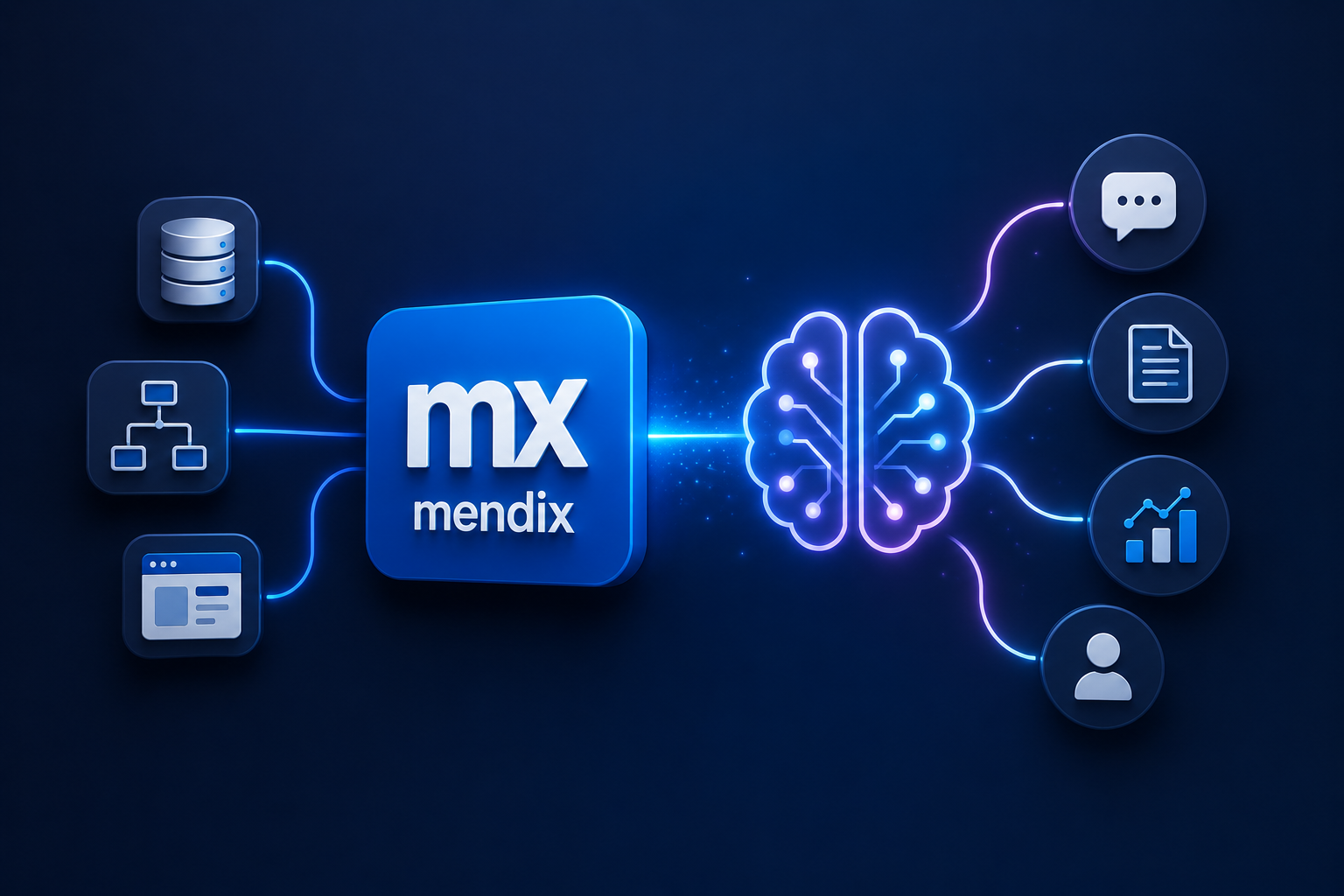
When Low-Code Becomes Intelligent Development
Artificial Intelligence has become the centerpiece of nearly every technology conversation over the past two years. Unfortunately, much of that conversation has been dominated by hype. Every platform claims to be “AI-powered,” and every product promises to revolutionize software development.
As a Mendix developer, I think we’re asking the wrong question.
The question isn’t “How do I add AI to my application?”
The better question is “What problems become solvable when my application can reason, understand, and communicate like a human?”
That’s where Mendix becomes incredibly interesting.
Mendix Was Already Good at the Hard Part
One of Mendix’s greatest strengths has always been eliminating the repetitive work involved in building business applications.
Creating data models.
Building workflows.
Managing security.
Creating responsive interfaces.
Connecting to enterprise systems.
Those tasks consume an enormous amount of development time, yet they rarely differentiate one application from another.
By handling those concerns, Mendix allows developers to focus on solving business problems instead of plumbing.
AI extends that philosophy.
Rather than replacing development, AI removes another layer of repetitive work—not in writing software, but in interpreting information, making recommendations, generating content, and helping users make decisions.
Instead of simply digitizing a business process, we’re now able to make that process intelligent.
AI Is More Than a Chatbot
When people hear “AI,” they often picture a chatbot sitting in the corner of an application waiting for questions.
That’s certainly one use case, but it’s probably one of the least interesting.
Modern AI models can understand documents, summarize conversations, classify images, extract structured data, generate reports, identify anomalies, predict outcomes, translate languages, write code, and even reason through complex business rules.
The question becomes:
Where can these capabilities remove friction from an existing workflow?
Imagine an insurance adjuster uploading a claim packet.
Instead of spending twenty minutes reading through dozens of pages, the application could automatically:
- summarize the claim
- extract policy numbers
- identify missing documentation
- estimate claim complexity
- highlight potential fraud indicators
- recommend next steps
The user isn’t interacting with “AI.”
They’re simply using a smarter application.
That’s a subtle but important distinction.
Mendix Makes AI Easier to Consume
One reason AI adoption has accelerated so quickly is that most providers expose their models through REST APIs.
For Mendix developers, that means AI is simply another service.
Whether you’re integrating with Azure OpenAI, OpenAI, Amazon Bedrock, Google Vertex AI, Anthropic Claude, or an internally hosted large language model, the overall pattern remains remarkably similar.
A microflow collects context.
The application builds a prompt.
The model returns structured information.
The application validates the response and incorporates it into the business process.
Because Mendix already excels at orchestrating workflows and integrating external services, AI becomes another component rather than an entirely new architecture.
Practical Applications That Deliver Immediate Value
Some of the highest-value AI implementations aren’t flashy—they simply eliminate tedious work.
Intelligent Document Processing
Organizations receive thousands of invoices, contracts, forms, medical records, engineering drawings, and compliance documents every day.
Instead of requiring employees to manually review each one, AI can classify documents, extract key fields, identify missing information, and route them automatically through existing Mendix workflows.
Hours of manual effort become seconds.
Smarter Search
Traditional search looks for matching words.
AI searches for meaning.
Imagine searching for:
“Show me every customer who’s frustrated with delivery delays but hasn’t contacted support.”
No predefined report.
No SQL query.
No custom filter.
The AI understands the intent and retrieves relevant information.
That’s a dramatically different user experience.
Decision Support
AI shouldn’t replace business decisions.
It should improve them.
A Mendix application can present recommendations, identify unusual trends, explain why a recommendation was made, and allow the user to make the final decision.
Humans remain accountable.
AI becomes an advisor.
Personalized User Experiences
Not every employee needs the same dashboard.
Not every customer needs the same interface.
AI can tailor recommendations, prioritize information, summarize activity, and surface the most relevant content based on the user’s role, history, and current task.
Applications become adaptive instead of static.
AI Doesn’t Replace Good Software Design
One mistake I’ve seen repeatedly is treating AI like magic.
It isn’t.
AI can produce incorrect information.
It can misunderstand context.
It can confidently provide the wrong answer.
That’s why application architecture still matters.
Business rules belong in the application—not the language model.
Validation still matters.
Security still matters.
Governance matters even more.
Think of AI as an intelligent collaborator, not the source of truth.
Your Mendix application should verify, constrain, and guide AI output before presenting it to users or committing it to a database.
The Real Opportunity
The most exciting aspect of combining Mendix with AI isn’t faster development.
Mendix was already fast.
The opportunity is building applications that weren’t economically feasible before.
Applications that understand natural language.
Applications that learn from historical data.
Applications that summarize thousands of documents in seconds.
Applications that help employees make better decisions instead of simply collecting information.
Applications that feel less like software and more like knowledgeable coworkers.
We’re entering an era where users won’t judge applications solely on how quickly they complete a workflow.
They’ll judge them on how much thinking the application does on their behalf.
For Mendix developers, that’s an exciting shift.
Low-code has always been about accelerating development.
AI is about accelerating intelligence.
When you combine the two thoughtfully, you’re no longer just building software—you’re building systems that help people work smarter, make better decisions, and spend more time on problems that genuinely require human creativity.
And I suspect we’re only scratching the surface of what’s possible.
Leave a Reply